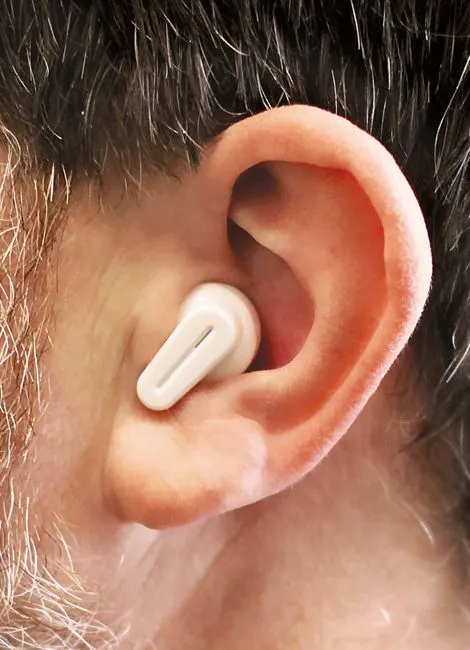
Tinnitus revisited

March 11th, 2008 No Comments

The effects of tinnitus on daily life can be classified on a scale from “slight” to “catastrophic”, differentiated by the imposition it causes, such as sleep interference, and the degree to which it can be overridden or ignored.

There are no established comparative clinical tests to evaluate subjective tinnitus, although it is sometimes possible to estimate the amplitude of objective tinnitus.  Use of a questionnaire such as the Tinnitus Handicap Inventory is the most common method of categorizing tinnitus.

There are no proven drug or nutrient treatments for subjective tinnitus.  If indicated, objective tinnitus can sometimes be treated with surgical intervention.  Use of a tinnitus masker, which is a device that looks like a hearing aid but generates noise to mask the tinnitus, may reduce the perception of the tinnitus.  Hearing aid wearers also often report that they do not hear their tinnitus when they are using their hearing aids.  Tinnitus Retraining Therapy (TRT) is another possible treatment.

Perhaps the best treatment of tinnitus is prevention.  Avoiding prolonged exposure to loud noise, the leading cause of tinnitus, by using hearing protection, is highly recommended.  Checking medications for possible side effects before taking them may also reduce potential damage to hearing.

Due to the potential psychological stresses and physical conditions that are involved, it is always a good idea to consult your physician at the onset of recurring tinnitus.

Why would a doctor tell his patient that hearing aids would be of no help to him?

This has always bothered me.  How can a physician offer no hope when the patient has had a hearing loss confirmed?   With the astonishing, brilliant technology available in today’s hearing aid industry, why do we still hear so frequently that family doctors – even some ENT’s – tell the patient that hearing aids won’t really help him.

First of all, whatever a physician’s specialty, you can be assured it is not hearing aids.  This field of study falls to audiologists, who have devoted 6-8 years of academic study so that they might alleviate hearing impairment.  Because fitting hearing aids is as much an art as a science, it takes many years of experience with customers to be able to manipulate effectively the myriad of instruments available to the millions of candidates.

A short history lesson might explain where such a person developed his obsolete perspective on amplification.  In the olden days of hearing aid technology (1950-1990), analog circuits were unable to offer amplification above 1800Hz.  Adventitious hearing loss (presbycusis) occurs in the high frequencies first.  Old aids couldn’t touch the frequencies where the loss was occurring.  Instead, they would amplify the low frequencies where the hearing was best.  Thus, no improvement in hearing was realized, but everything became overamplified.  The doctor was right: no help from amplification.

Today, the ADRO circuit used in America Hears’ aids amplifies 32 frequencies, as high as 6000Hz – the highest frequencies of speech.  Each frequency is manipulated individually:  amplification is provided precisely where it’s needed.  With open fittings, the possibility of superfluous amplification is deleted. 

Recent evidence has shown that some ears that suffer from “Dead Regions” in the cochlea can experience ‘tonal perversion’ from too much or any high frequency amplification.  This is a discovery only revealed now because of today’s advances.  However, given the frequency specificity of the ADRO circuit, nerve cells adjoining dead regions may be stimulated, restoring high frequency hearing never before reached.

 Should your doctor suggest a hearing aid wouldn’t help you, question it and do your own research.

The Inner Ear, Part 2

February 26th, 2008 No Comments

The Inner Ear Part II

The semicircular canals are the balance center located in the inner ear.  These are 3 fluid-filled canals lay in 3 perpendicular planes which helps to orient you in your environment.   When you move your head, the fluid in the canals moves, causing the tiny hair cells that line the canal walls to move as well.  These hair cells are connected to nerve receptors and when they move, they transmit signals to the brain. 

If there is a problem in the semicircular canals, the result will be dizziness.  The degree of this dizziness will vary in each person.  

Tinnitus, part III

February 20th, 2008 No Comments

As previously mentioned, subjective tinnitus is present in quiet and noisy environments.  The mechanisms of tinnitus are obscure.  One possible explanation is abnormal oscillation of the inner ear hair cells.  Another is damage to the inner ear receptor cells that results in false information being relayed to the brain that an external, audible sound is present when it is not.

Otologic conditions that result in tinnitus accompanying conductive hearing loss include middle ear effusion, impacted cerumen (earwax) and/or an external ear infection.

The most common cause of tinnitus accompanying sensorineural hearing loss is prolonged exposure to excessive noise (noised induced hearing loss).

Additional causes include  presbycusis (age related hearing loss), Meniere’s Disease, acoustic trauma, and acoustic neuroma (tumor of the VIIIth Cranial Nerve).

Use of ototoxic drugs and other physical conditions may also result in tinnitus, with or without accompanying hearing loss.  Medications such as aspirin and anti inflammatories, and antibiotics such as tetracycline and gentamicin have been shown to cause tinnitus and/or hearing loss.  Neurologic conditions such as Multiple Sclerosis, head injury, metabolic disorders such as thyroid disease, and psychological disorders such as depression and anxiety are some of they physical conditions that may have associated tinnitus.

A discussion of testing for and treatment of tinnitus will be upcoming.


I’m taking a time out from the anatomy lessons to alert you to two recent articles I found related to hearing aids.

http://www.wired.com/culture/culturereviews/magazine/16-02/su_hearing_aids

http://online.wsj.com/article_email/SB120156046709123567-lMyQjAxMDI4MDMxMDUzNjAwWj.html

Tinnitus, continued

January 29th, 2008 No Comments

There are two types of tinnitus: objective and subjective.

Objective tinnitus, which is much less common, is sound coming from the patient’s ears that is perceived by an outside listener. This may be caused by muscle spasms. It can be ‘pulsatile’ as well; the tinnitus beats in time with the patient’s pulse. This can be caused by athereosclerosis, an inflammatory condition of the artery walls (hardening of the arteries), or rarely, be a symptom of a potentially life threatening disease such as carotid artery aneurysm or dissection.

Subjective tinnitus is far more common, and is audible to the patient only. There are two classifications of subjective tinnitus: otic and somatic. Otic tinnitus is caused by an otologic disorder of the inner ear or auditory (VIIIth cranial) nerve. Somatic tinnitus is caused by a disorder outside of the inner ear or auditory nerve, but still within the head or neck.

There are many otologic disorders that can result in subjective tinnitus, and these will be addressed in more detail in the coming week.

The Inner Ear - Part 1

January 14th, 2008 No Comments

The inner ear is the third part of the ear.  There are 2 functions of the inner ear, balance and hearing.  We will break these down into two sections to explain how they work and what can go wrong.

The inner ear consists of fluid-filled “tubes” running through the temporal bone of the skull.   These “tubes” are called the bony labyrinth.  There are 3 sections within the bony labyrinth, the cochlea (hearing), the semicircular canals (balance) and the vestibule (balance).

The inner ear has two membrane-covered holes into the middle ear – the oval window and the round window.  The stapes (of the middle ear) is seated in the oval window and  when the stapes rocks against this window it sets the fluid of the inner ear into motion.  Since this is a closed “tube” and the round window acts like a pressure release and bulges outward as the fluid is in motion. 

Over the next couple of weeks, we will discuss the semicircular canals and vestibule as it relates to balance and then we will discuss the cochlea and its role in how we hear. 

Tinnitus

January 7th, 2008 No Comments

Tinnitus (t?-n?’t?s, t?n’?-) is one of the most common complaints of people with hearing loss.  It is defined as “the perception of sound in the human ear in the absence of external, corresponding sound(s)”.

Tinnitus can be present in one or both ears, and is commonly described as ringing, buzzing, hissing, humming, ticking, clicking and/or whooshing sounds.

It is not a disease, but it can be a symptom of such conditions as ear infections, foreign objects and/or ear wax in the ear, injury/trauma, and noise exposure.  It can also be a side effect of oral medications such as aspirin.

Tinnitus can range in severity from being only noticeable during quiet activities, to interfering with normal activities and sleep.  Because it is usually a subjective phenomenon, it is difficult to measure and quantify.

Over the next few weeks, we’ll discuss in detail the types, causes, and treatment of tinnitus.

The middle ear is an air-filled cavity consisting of the tympanic membrane (ear drum), the malleus (hammer), incus (anvil), stapes (stirrup), Eustachian Tube, ligaments and tendons. The purpose of the middle ear is to transmit the sound energy from the outer ear to the inner ear. Sound pressure on the ear drum creates motion which rocks the bones of the middle ear and pushes the footplate of the stapes into the oval window of the inner ear.

The eustachian tube plays an equally important role in middle ear function. It opens at one end in the middle ear and at the other end in the back of the throat. The purpose of the eustachian tube is to equalize the air pressure behind the ear drum to the air pressure around us and to aerate the middle ear. At rest, the eustachian tube is closed. When we swallow or yawn, air from the throat enters the tube and goes into the middle ear. This often gives us the sensation of our ears “popping”, like when we experience a change in elevation.

Diseases of the Middle Ear:

Otitis Media is an inflammation of the middle ear, usually as a result of a middle ear infection. It may occur in one or both ears. This is the most frequently diagnosed problem for children. It can result in severe earache and conductive hearing loss. If treated in a timely manner, hearing loss can almost always be returned to normal.

Otosclerosis is a progressive, degenerative condition of the bones of the middle ear, resulting in a conductive hearing loss. It usually begins in one ear but will eventually effect both. Women are twice as likely as men to be affected. Generally speaking the stapes becomes fixated to the oval window of the inner ear, thus restricting or prohibiting the movement of the stapes into the inner ear. It must be corrected surgically with a procedure called a stapedectomy. The stapes is removed and an artificial stapes is inserted.

A cholesteatoma is an abnormal skin growth, usually due to repeated infections. It is often described as a cyst or pouch that holds old skin and builds up in the middle ear. If left untreated, it will increase in size and destroy the delicate bones of the middle ear. This must be surgically removed.

Disarticulation is when the bones of the middle ear become “disconnected”. This is most always a result of some physical trauma to the ear or head. This will cause a conductive hearing loss and must be corrected surgically.

Audiogram, continued

December 17th, 2007 No Comments

The last parts of the audiogram we are going to address are the Most Comfortable Level (MCL) and Uncomfortable Level (UCL).

There are no standardized tests for the MCL and UCL, and they can be determined using speech or pure tone stimuli (more commonly using speech).

The Most Comfortable Level (MCL) is the hearing level at which speech is most comfortably loud; it is usually the level at which, or near, speech discrimination is maximized. The MCL is used to estimate the amount of gain required in the hearing aid.

The UCL is also known as the Loudness Discomfort Level (LDL), Uncomfortable Loudness Level (ULL) and Threshold of Discomfort (TD). The UCL is the loudest level the listener can tolerate without feeling uncomfortable. It is important for setting the maximum output level of the hearing aid. Patients with sensorineural hearing loss will usually have lower UCLs and narrower dynamic ranges than those with conductive or mixed hearing losses.

These measurements can vary widely from listener to listener, and while no longer required when purchasing hearing aids, they nevertheless provide useful information for programming your hearing aids.